Lodge Morland No. 25 G.L.I
Hyderabad, India
Lodge Morland No. 25 G.L.I
Hyderabad, India
History of Morland
Lodge Morland - A Brief History
R.W.Bro. P. Vijaya Kumar
It is indeed rare to find any association of voluntary character to survive after one century. But in freemasonry, nearly 90 out of the over 400 Lodges under GLI in India have already completed a century of service. This is due to the inherent strength of freemasonry as it existed, from the written records found, for nearly 400 years and upwards. Lodge Morland is one such lodge. It completed its 150th year this year and it is one of the few lodges which exists till now with very active participation of many brethren, numbering Committee and only after it was approved, more than one hundred for most of the time.
In the twin cities of Hyderabad and Secunderabad, it was the first lodge under the Scottish Constitution. Till then, three lodges existed, namely St. John’s Lodge, Mayo Lodge and Lodge Deccan. The first two were essentially started by members of the Armed Forces, though Mayo Lodge had many civilians on its rolls. Lodge Morland also had many Service brethren, but there were equal number of civilians as its members, though most of them happened to be Englishmen. As English were then the ruling class, it was but natural that many civilians were eager to join the lodge to be nearer to the ruling administrators. Still, if we glance through the initiation records, the first to be initiated after six months after consecration of the Lodge, was Narasimulu Chetty, Superintendent of Customs. The next was Md. Sahabuddin, a civilian who was initiated after another nine months. In 1877, there was only one initiation – that of A.W. Forbes. In 1878, there were no initiations and in 1879, only two- a hospital assistant and a dental surgeon.
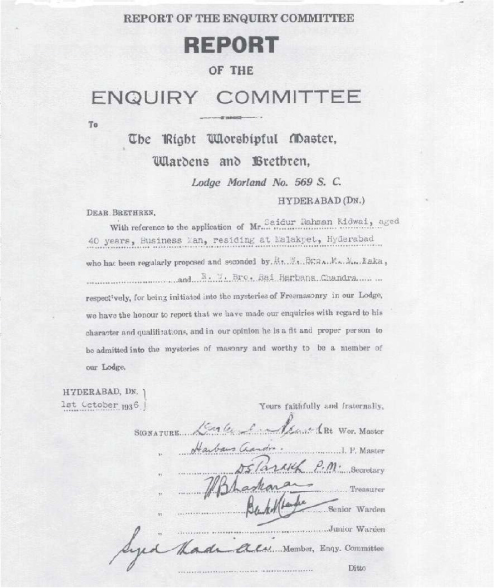
In those days, the members of the Lodge were very particular as to the quality of its members and they were not excessively concerned with numbers. A Screening Report, called “Enquiry Report” (Appendix- I) was submitted to the Standing the candidates were taken in.
Lodge Morland was constituted under a Dispensation granted by the Grand Master of All Scottish Freemasonry in India, M.W.Bro. Henry Morland on 21st March, 1875 in response to a petition made by W.B. Johnson, Charles Kirkman, Joseph Hulme Taylor, M.H. Wilkinson, C.B. Dunlop, H. deq Sewell, J. Houlihan and others, which dispensation was confirmed under a charter from Grand Lodge of Scotland on 3rd May, 1875 and the Lodge regularly opened on 15th December, 1875.
Though W.B. Johnson was to be the first Worshipful Master according to the Charter, from the Lodge records, it is found that M.H. Wilkinson was the founder Master. The reasons for this change are not known. Many other details are unfortunately not known as the Minutes Books and records for the first nearly two decades are not to be found. M.H. Wilkinson was the Secretary to the Nizam Government in the Department of Public Works and was a very prominent person in Hyderabad social circles. He was a great friend of Sir Henry Morland, the Grand Master of All Scottish Freemasonry in India (ASFI) and accordingly, the Lodge was named after him. The Lodge used to meet at St. John’s Hall, Secunderabad, but after a very short time, differences cropped up between St. John’s Lodge and Lodge Morland. For some time, it was meeting at various places and after reconciliation with St. John’s Lodge, it was once again meeting at St. John’s Hall and finally in 1892, it was granted land near Fateh Maidan and a building was constructed. It costed nearly Rs.30,000, out of which Rs.7.600 was contributed by the Lodge, the balance amount was a loan from a private financier at an interest of 6% p.a.
The building was dedicated to Masonry in 1893 and a banquet was held in the palace of Sir Asman Jah, the Prime Minister of Nizam’s Government. The membership by now was nearly 100.
And then dissensions arose. In the words of J.D.B. Gribble, a past master of the Lodge (1891-93) and author of “History of Freemasonry in Hyderabad (Deccan)”. `passions were excited, masonic principles forgotten and the result was that the election of Worshipful Master was cancelled and in 1896, the W.M. still in charge was suspended”. Finally, Gribbles was ordered by Grand Lodge to take over till alternate arrangements were made. There was no possibility of paying the debt incurred for the building construction. At this time, J.D.B. Gribbles, Bakshi Raghunath Prasad, a Judge of Nizam’s High Court, Sheik Mohammed Moinuddin, A.G. Fellows and Pestonji Jivanji took it upon themselves to work out a strategy to save the Lodge from extinction and after one more year after A.G. Fellows became Worshipful Master, the building was sold to Col. Afsar- ul-Mulk, the Commandant of H.H.’s Regular Troops and Imperial House as a Mess House for the officers and permission was given to the Lodge to occupy the former Mess House situated at Ghoshamahal. The new premises, an old royal palace known as Ghoshamahal Baradari, became the meeting place and after subsequent developments, became the property gifted by the Nizam for the purposes of freemasonry in his dominions. All the Lodges meeting at Hyderabad started meeting at this place. Lodge Morland, thus, because of the tremendous influence exerted by its members, was instrumental in acquiring a permanent building for freemasonry in Hyderabad.
Very little is known about J.D.B. Gribble, such as his occupation, service details, etc., other than that he was a Retd. Madras Civil Servant. He joined freemasonry in Lodge Surates at the East of Bucharest No. 33, Romania. During his mastership of Lodge Morland in 1891-93 (Appendix-II), he composed hymns (Appendix-III), to be sung in the Lodge, wrought major reforms in the administration of the Lodge and subsequently wrote an authoritative history of Freemasonry in Hyderabad (Deccan).
His election and installation as Worshipful Master of Lodge Morland was a little controversial but finally it was settled. It so happened that during Election Meeting on November 28, 1891, the Worshipful Master was not present. Only one Past Master was present who was a member of the Lodge, but a Past Master of Lodge Deccan of English Constitution. Accordingly, due to absence of Depute Master, Substitute Master J.D.B. Gribble presided over the Lodge. In the election, J.D.B. Gribble was elected by majority of the brethren present. Subsequently, the Ruling Master wrote to the Grand Lodge that the election was illegal since a Past Master of the Lodge was not presiding over the Lodge at the time of election. Moreover, the election was held in the first degree and not in the third degree. To their surprise, Gribble and other officers and the Secretary, received a telegram from Grand Lodge on the morning of 21st December informing them that the election was illegal and ordered fresh elections and postponement of Installation. Gribble replied by telegram at 1 p.m. on that day the circumstances which led to the election with Substitute Master presiding and since it is not clear from the Book of Constitutions whether Election of a Master can be held in a Lodge presided by a Substitute Master, a dispensation may be given to proceed with the Installation as already the invitations were sent and were accepted by more than 50 guests. In the evening the meeting was held and a telegram from the Grand Lodge was received permitting Installation proceedings.
Unfortunately, due to lack of records, the history of the formative years of the Lodge cannot be written. From few scraps of information available, one gets a picture that the Lodge was very vibrant and took a lead in the functioning of other lodges and even in the formation of another Scottish Lodge in Hyderabad today’s Lodge Hyderabad No. 50 – which is the only Lodge in the world to work its rituals in Urdu.
Lodge Morland was for quite some time, maintaining the properties on its own. It was allowing the other Lodges to use its furniture and was lending its crockery, cutlery, etc., without any charges for quite some time. But after some time, it was noticed that a lot of breakages were there and it was decided to charge the user Lodges Rs.150/- per Lodge for replenishing the crockery. Accordingly, letters were sent to (a) St. John’s Lodge (b) Lodge Mayo (c) Lodge Deccan and (d) Lodge Keystone.
No records are available from this point till about 1920s. As a matter of interest, only two events stand out in the period from 1920 to 1930.
Till 1924, there was no post of Chaplain in Lodge Morland. Whether this omission was as per the existing procedures at that time or by oversight is not known. On receipt of a letter from Grand Lodge to that effect, the first Chaplain was invested in February 1924. He was Bro. S. Jamaluddin. In July 1920, Grand Lodge of A.S.F.I. issued a circular to all daughter Scottish Lodges that Conclave of the Order of the Secret Monitor is not recognised by them and any member of Scottish Lodge having any connections with that body would be expelled from Scottish Freemasonry.
Scanning the subsequent records, it is found to contain routine proceedings, with the usual discussions, dissensions, etc., except the major landmark event of getting a Firman from the Nizam of Hyderabad gifting Ghoshamahal Baradari Building for Freemasonry, represented at that time by Lodge Morland, Lodge Deccan and Lodge Hyderabad. Sir Terence Keyes, Resident, British Govt., played a key role in getting this building for freemasonry, he himself being a past Master of Lodge Ekram No. 45 (Appendix-IV). Subsequently, the building was completely rennovated, preserving all the fine work which was originally present and altering some parts of the building to suit the functioning of Masonic Lodges by the indefatigable efforts of R.W.Bro. Meher Ali Fazl, ably assisted by Bro. Chandulal Dangoria.
Lodge Morland, from its beginning, set up a tradition in maintaining the quality of Ritual Working, but of course, during some brief periods, it might not have been good, but the members were conscious of it and tried to bring it back to normal good standards as soon as it was possible.
Once when the M.W. Grand Master, M.W. Bro. D.P. Madon visited the Lodge, in the course of the proceedings, the Lodge was resumed from the III Degree to the I Degree. The Grand Master, observing this, strongly suggested that the Lodge should always be regularly closed in the III and II Degrees, and that short method should not be used as far as possible.
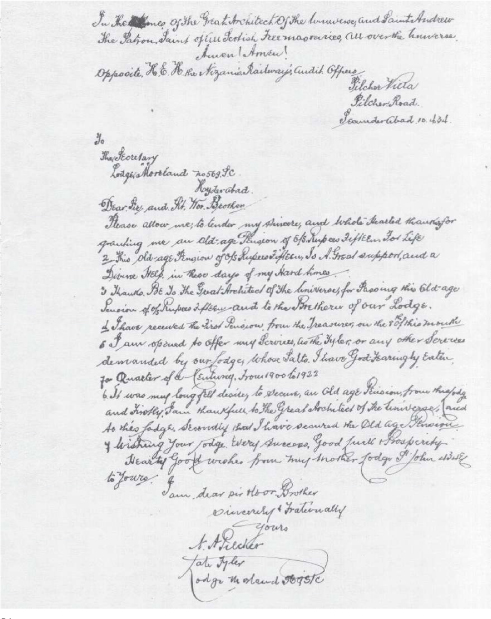
Funds of the Lodge have always been sound and the Lodge was always in the forefront of contributing to charitable activities. It may be mentioned that Lodge Morland was giving relief to brethren not only of their Lodge, but all others also as evidenced by granting of Rs.15/- (BG) per month in 1935 to Bro. C. Framji Dadabhoy of Shahbad and Rs.15/- (BG) per month in 1934 for life to W.Bro. Ardasir Ruttonji Pilcher of Lodge St. John (also a past master and Tyler of Lodge Morland) (Appendix-V). In 1977, it was Lodge Morland that proposed setting up of a Medical Clinic in the Ghoshamahal Baradari premises for the benefit of the poor residing in that locality. The Lodge has been participating in the Ritual Working Competition every year since 1975.
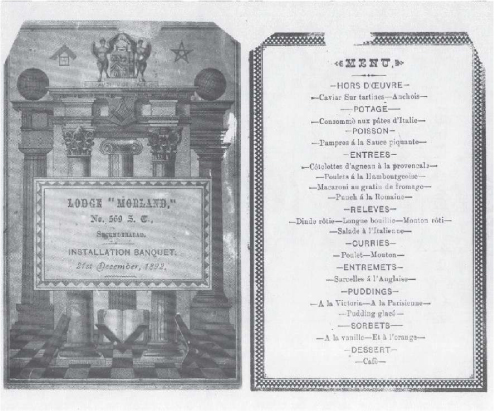
The Lodge was very particular in preparation of table plan for every major function and maintained its high standards in conducting Installation banquets. For Installations, they used to import partridges from Bangalore and even now there is a tradition of having cigars after the Installation dinners.
The Lodge had from the beginning, maintained its elite character and had attracted many illustrious members of the society to join the Lodge.
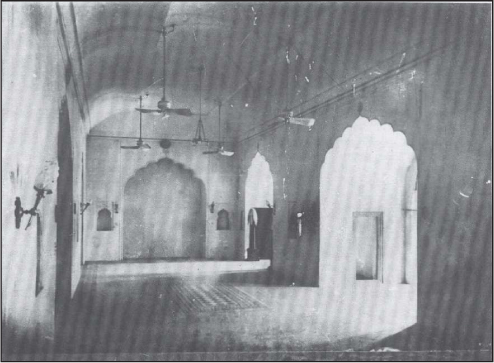
A view of the Goshamahal Baradari Building Temple after rennovation in 1933
Installation Banquet Menu Card
(of W.Bro. Gribble on December 21. 1892)
MASONIC ANTHEM
by J.R.D. Gribble
The following Masonic Anthem was written when I was in the chair of Lodge Morland, and was afterwards adopted in Lodge Mayo and Lodge Heather. Two or three verses are sung at the opening, and the remainder at the close of the Lodge, when the Master and officers enter and leave. It adds much more to the solemnity of the function, if the Rt. Wor. Master both enters and leaves with his officers in procession, in the same way as Grand Lodge does. The hymn can be sung whilst this is taking place. By sending it as a contribution to the Jubilee Issue it may be made known to other Lodges. It can be sung to the tune of “The Church’s one foundation”.
We pray our ancient order, May rule throughout the land, And we may form as Masons, One strong, united band, No quarrels here, no discord, No envy shall prevail, For to the vows we have taken, In duty none shall fail.
Our craft each creed embraces, Each colour and each race, Here every man’s a brother, For each we have a place, One faith we have in common, In one we all confide, Oh! May the Master’s presence, Here in our Lodge abide.
Of one colossal temple, We all form living stones, In which, by love cemented, Love speaks in gentle tones, Here all meet on level, And act upon square, And this our rule of conduct, In all things just and fair
Oh! May the Eye all seeing, Be with us every day, And may we feel its presence, In all we do and say, The vows we have spoken, Shall form our rule of life, And we will live as brethren, Without one thought of strife.
Thus can we do our duty, And thus fulfil our trust, Thus can we form, thus only, A prefect Lodge and Just, Until the last dread summons, Shall call us hence, above, To the Grand Lodge in Heaven, The Lodge of Perfect Love’.
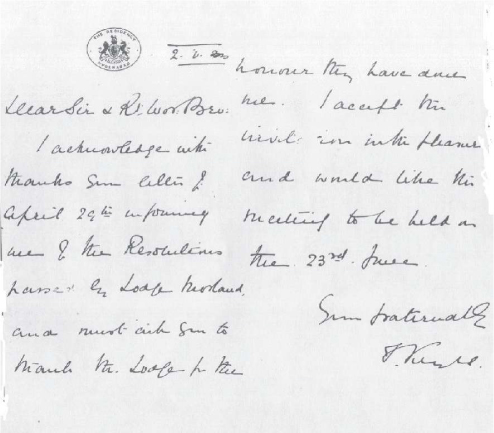
Sir Terence Keyes, Resident of British Govt. in the Hyderabad State, sends a note in his own handwriting to the Worshipful Master of Lodge Morland, accepting an invitation by Lodge Morland to felicitate him on 23rd June, 1934.
Letter dated 10.4.1934 written by Ardasir Ruttonji Pilcher to the Secretary of Lodge Morland, thanking the Lodge for sanctioning an old age pension of Rs.15/- per month for life.
NAWAB ZOOLCADAR JUNG BAHADUR
Nawab Zoocadar Jung was born in 1875. After receiving his education at Madra- e-Aiza, St. George’s Grammar School, Scottish High School, Bombay, he passed his matriculation from Madras in 1893. H.H. the Nizam sent him to England in 1894. He took his B.A. degree from Cambridge in 1897 and M.A. degree in 1899. He passed Bar examination in December 1899. On his return he was appointed 2nd City Magistrate. After a lapse of time he was elevated to High Court in 1907. He retired in 1915 and for a while resided in Lucknow. In 1921 he was recalled by H.E.H. the Nizam and appointed as Home Secretary. He was the Wor. Master of Lodge Morland for three consequtive yeas 1924, 1925 and 1926.
RAJA SRINIVASA RAO BAHADUR
Among members of the nobility of Hyderabad, Raja Srinivasa Rao Bahadur occupies a very high rank by virtue of his literary attainments, general scholarship and the worth of character. Graduate from Bombay University he did his B.A. in Civil Law from Oxford. Srinivasa Rao was born at Kanamadi in Bijapur District. He Joined Deccan College, Pune and graduated. He had deep interest in social work. He was the President of Karnataka Sangh.
Raja Srinivasa Rao was Mansabdar in Nizam’s Dominion. One of his ancestors came to Deccan during the time of Sikandar Jah from Indore and settled in Gulbarga. His son Krishnaji Naik earned Jagirs in Mahboobnagar and Gulbara. He was one of the most trusted officers of the Nizam and moved in the highest official and social circles. He died in 1856, leaving only son late Raja Srinivasa Rao. After receiving his education in Urdu and English he entered the services of Nizam in 1877, as Assistant Military Secretary. In 1881 he was appointed to hold in addition the Superintendentship of the household of the Jagirs of deceased Arab Hashmuth bin Mohsin Mukkadam Jung. In 1884 he was placed in charge of Central Treasury (Khazan-e-Amara). He was appointed as a Trustee of the estates of Late Raja Kandaswamy and also temporary administration of the estates of Raja Rayan. Sir Asman Jah made him Talugdar Gr. I and posted to Nalgonda. In 1889 the title of Raja was conferred on him. He passed away in 1905 leaving behind one son, Kishen Rao. Unfortunately Kishen Rao died very early in 1907. 12 years after her husband’s death Rani Rukmini Bai adopted Shanker Rao and gave him the title of Raja Srinivasa Rao who was a member of Lodge Morland.
NAWAB LATEEF YAR JUNG BAHADUR
M.A. Lateef Khan was brought to Hyderabad by his father Moulvi Abdus Sattar Khan who was an eminent educationist for half a century. He obtained a Diploma from Darul Uloom Institute of Hyderabad. He also passed in first grade his Pleadership (Darj-e-awwal) examination and also Revenue Test of higher grade. After having worked for some time in the Accountant General’s office, he was transferred to Revenue Department in the Revenue Secretariat. He slowly rose to become Tehsildar and Deputy Collector. His extraordinary ability and honesty of purpose drew attention of the Paigah, Sir Vikar-ul-umra. He worked in Paigah for 7 years, then became a Judge of the Paigah court. He returned back to the parent department and was appointed as Talukdar in Excise Department. He rose to become Excise Commissioner. During his stewardship he raised the revenue from Excise to Rupees 1.25 crores. His sincerity of purpose and exemplary honesty was very well spoken in many of the Government reports. He was awarded the Jung title in 1923. He did not hesitate to become the Tyler of Lodge Morland, despite being in such a high position.

It is therefore of interest that within 12 years of the constitution of the Grand Lodge of England, constituted for the purpose of exercising supervision over the lodges in London, and its neighboring areas, a petition was sent by a few Brethren in India to constitute a Provincial Grand Lodge in Calcutta. The Petition having been granted, a Provincial Grand Master was appointed to supervise Masonic activity in India and the Far East in 1728 A.D.
Full details regarding how the First Lodge was constituted in India, are preserved in the Minutes of the Grand Lodge in London. First a petition was presented on December 28, 1728 and at the end of the minutes of that meeting, the text of the “Deputation” from the Grand Master: “to Empower and Authorize our well beloved Brother Pomfret….that he do, in our place and stead, constitute a regular Lodge, in due form at Fort William in Bengal in the East Indies….” This was signed and sealed “the 6th day of February 1728/9 and in the year of Masonry 5732 (which shows that Grand Lodge used Usher’s Chronology in dating the Masonic era – as the Grand Lodge of Scotland still.
The Lodge at Fort William — that is, Calcutta — appears in the Engraved List of 1730, as No. 72. It was to meet at Fort William in Calcutta. The coat of Arms was adopted from the East India Company a golden lion, rampant guardant, supporting between the forepaws a regal crown. In 1729, Captain Ralph Farwinter was appointed “Provisional Grand Master for East India in Bengal” and also James Dawson as “Provincial Grand Master” for East Indies.